Standard Form of Linear Equations
Introduction
In this article, we explore standard form, another common way to write linear equations.
We assume you already understand slope-intercept form ($y = mx + b$), so our goal is to connect what you know to a new, useful format.
Standard form is especially helpful when:
- You want to find intercepts quickly
- You want to avoid fractions
- You want a clean, symmetric-looking equation
What Is Standard Form?
A linear equation is in standard form when it looks like: $$Ax + By = C$$ Where:
- $A$, $B$, and $C$ are integers
- $A$ should be non-negative
- Fractions are usually cleared
- $x$ and $y$ appear on the same side
Examples:
- $2x + 3y = 12$
- $x - 4y = 7$
Why Standard Form Is Useful
Standard form makes some tasks easier:
1. Finding the $x$-intercept
Set $y = 0$:
- Solve $Ax = C$
- Intercept is $(\frac{C}{A}, 0)$
2. Finding the $y$-intercept
Set $x = 0$:
- Solve $By = C$
- Intercept is $(0, \frac{C}{B})$
3. Avoiding fractions
If an equation has fractions, standard form lets you multiply everything to clear them.
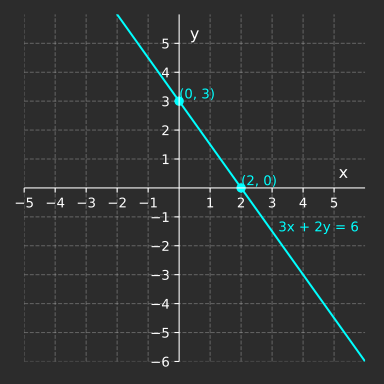
4. Cleaner graphing
Two intercepts are often enough to sketch the line.
Converting Slope-Intercept Form to Standard Form
Start with: $$y = mx + b$$ Steps:
- Move $mx$ to the left: $-mx + y = b$
- Multiply by $-1$ if $A$ becomes negative
- Clear fractions if needed
Example: $$y = \frac{3}{2}x - 4$$ Move $x$ term: $$-\frac{3}{2}x + y = -4$$ Multiply by $-2$: $$3x - 2y = 8$$
Converting Point-Slope Form to Standard Form
Start with: $$y - y_1 = m(x - x_1)$$ Steps:
- Distribute $m$
- Move all terms to one side
- Clear fractions
Example: $$y - 5 = 2(x + 1)$$ Expand: $$y - 5 = 2x + 2$$ Move terms: $$-2x + y = 7$$ Multiply by $-1$: $$2x - y = -7$$
Graphing Using Standard Form
To graph $Ax + By = C$:
- Find the $x$-intercept
- Set $y = 0$
- Solve $Ax = C$
- Find the $y$-intercept
- Set $x = 0$
- Solve $By = C$
- Plot both points
- Draw a straight line through them
Example: $$4x + 2y = 12$$
- $x$-intercept: $4x = 12 \Rightarrow x = 3$
- $y$-intercept: $2y = 12 \Rightarrow y = 6$
Graph the points $(3,0)$ and $(0,6)$.
Examples
Example 1: Convert to Standard Form
Convert $y = -3x + 2$.
Move $x$ term: $$3x + y = 2$$
Example 2: Convert to Standard Form (Fractions)
Convert $y = \frac12 x - 7$.
Move $x$ term: $$-\frac12 x + y = -7$$ Multiply by $-2$: $$x - 2y = 14$$
Example 3: Graphing
Graph $2x + y = 4$.
- $x$-intercept: $(2,0)$
- $y$-intercept: $(0,4)$
Exercises
- Convert the equation $y = 5x - 3$ into standard form.
- Convert the equation $y = -\frac23 x + 4$ into standard form.
- Write the equation of a line in standard form that has $x$-intercept $4$ and $y$-intercept $-2$.
- Convert the point-slope equation $y - 1 = 3(x + 2)$ into standard form.
- Graph the equation $3x + 6y = 12$ by finding its intercepts.
- True or false: The equation $4x = 8$ is already in standard form.
- Convert $y + 5 = -4(x - 1)$ into standard form.